

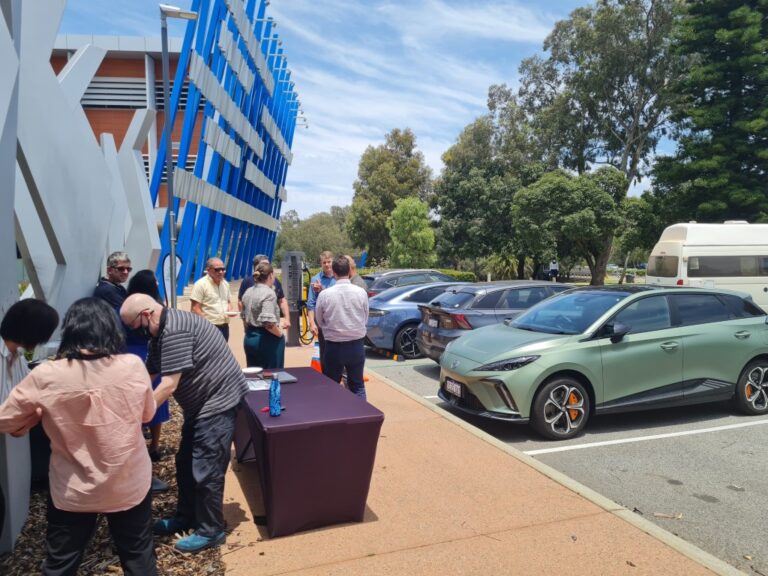
Following on from the Staff Lunch and Learn Sessions held at the City of Gosnells and the City of Armadale in November 2024, Switch Your Thinking has gone and done some research to answer some of the most common questions asked by staff on the day.
What is the difference between a Hybrid Electric Vehicle (HEV), Plug-in Electric Vehicle (PHEV) and a Battery Electric Vehicle (BEV)

The most basic difference between the three main types of EV available currently in Western Australia is the manner in which it is powered
Hybrid Electric Vehicles (HEVS)
A HEV still relies on a conventional fossil fuel combustion engine for the majority of its power. However, unlike a vehicle that relies solely on internal combustion, a HEV also has a small battery (average battery size 0.5-2 kWh). Unlike other EVs a HEVs battery cannot be recharged by an external charger. Consequently, the vehicle relies on internal charging through a combination of regenerative braking supplemented by the vehicle’s regular combustion engine. As regenerative braking is effective at replacing petrol with electric power at low speeds, a HEV is most suited to urban environments where there is more frequent stopping and starting.
Plug-in Hybrid Vehicles (PHEVs)
A PHEV is similar to a HEV in the sense that it is also powered by a combination of fossil fuel and battery power (average battery size 7-20 kWh). However, unlike a HEV you are able to recharge the battery using an external charger. Due to the larger battery size PHEVs can drive between 0 – 100km (depending on make/model) on battery power alone. However, it is generally better to drive the vehicle as a hybrid to improve fuel economy.
Battery Electric Vehicle (BEV)
Otherwise known as a plug-in, pure EV or zero emission vehicle (ZEV), this type of vehicle relies on rechargeable batteries alone for its power (average battery size 16kWh – 100kWh), which can be supplemented by regenerative braking. In addition, compared to HEV and PHEV alternatives there are zero tailpipe greenhouse emissions from a BEV.
Tax breaks, rebates and other financial incentives associated with EV ownership
The exemption on the Fringe Benefits Tax (FBT) under the Luxury Car Tax (LCT) threshold, applies to the sale of zero or low-emission vehicles valued under $89,332.00. The Australian Taxation Office (ATO) manages the FBT and the exemption is currently available to both BEVs and PHEVs. This exemption does not apply to HEVs such as the Toyota RAV 4 Hybrid, Toyota Corolla Hybrid, MG3 Hybrid, Honda CRV Hybrid, etc., because the small-sized battery in HEV is used to store the energy from regenerative braking and not as a fuel source. Even though HEVs use fossil fuel (petrol or diesel) it is still beneficial due to the greater fuel efficiency compared to a regular internal combustion engine (ICE) vehicle.
It is important to note that PHEVs (vehicles with both a rechargeable battery and a regular ULP or Diesel fuel tank) will be excluded from the FBT exemption from April 1st, 2025. There are also a number of additional requirements for FBT exemption and the ATO has developed a useful resource online including a list of different scenarios showcasing when the FBT does and does not apply. It is worth noting that the FBT exemption can be applied to EVs purchased through novated leases.
Since PHEVs and HEVs still emit tailpipe greenhouse emissions, they have been excluded from the Western Australian Governments $3,500.00 Zero Emission Vehicle (ZEV) Rebate. As part of the 2024-25 state budget, this BEV specific rebate, which is managed by the Western Australian Department of Transport (DoT) has been extended to the 10th of May 2025. Finally, to assist people with the upfront cost of purchasing either an EV or home chargers there are an increasing number of financial institutions offering either secured or unsecured green loans, which are typically available at a much lower interest rate than the market average. This is part of a commonwealth and state government push to make cleaner transport options available to more people. Readers are encouraged to do their own research and find out what is available, making sure to clarify which types of EV are eligible in each instance.
Maintenance and running costs of EVs compared to ICE vehicles
One factor that significantly reduces the cost of servicing BEVs when compared to ICE vehicles or even HEV or PHEV EV alternatives is the significantly reduced number of moving parts (engine, belts, chains, pipes etc.) In addition, BEVs tend to require far less lubricants to operate when compared to ICE Vehicles or even HEV or PHEV alternatives, which still rely on a regular combustion engine to offset their battery. Consequently, BEVs tend to be simpler to service and therefore require less labour hours, which significantly saves on the final bill. In addition, many EV manufacturers offer fixed-price servicing for the first 3-5 years of the vehicle’s operational life, which can result in further savings. Like all servicing, EV owners need to ensure it is done on time so that the vehicle warranty is not adversely affected. Finally, if a BEV, PHEV, or HEV is equipped with regenerative braking (a fairly standard EV feature in 2024) and the driver actively engages with this system it will save on the wear and tear on brake pads.
Depending on the EV purchased the above savings can be offset somewhat by the replacement costs of tyres. This is due to the added weight of the battery, which increases incrementally based on the vehicle type. Some EV manufacturers are looking to improve the quality of tyres the vehicle is provided with at purchase. At present the cost of parts for EV vehicles can also be higher than ICE equivalents as most of it comes from overseas, which increases transportation costs and wait times. The other major expense when purchasing any type of EV, especially a BEV is the replacement cost of the battery, which can be considerable. This is why most EV Manufacturers provide a separate six-to-eight-year warranty on the battery (see section on battery longevity and replacement costs for further information).
The running costs of an EV compared to an ICE vehicle depend on several different factors…
The fuel efficiency of the ICE vehicle Vs the HEV or PHEV equivalent model (varies by vehicle make and model).
The distance and type of driving: For example, HEVs get the best fuel economy from city driving where there is more opportunity to engage their regenerative braking to recharge the battery. PHEVs in comparison become less fuel efficient once their internal battery is depleted below a certain level. Finally, the battery capacity of a BEV dictates range endurance. It is important to note that the figures quoted by vehicle manufacturers are generally averages. Therefore, driving conditions as well as, driving behaviours can have varying degrees of impact. This is true for all vehicle types.
The price and fluidity of fuel vs the cost of electricity: The average price of fuel in Western Australia is fluid and tends to fluctuate throughout the week, whereas the price of electricity is generally stable. Electricity tariffs are subject to annual price changes.
The electricity tariff: The electricity tariff your home is on as well as the time of the day you charge has a significant impact on the overall cost of running a PHEV or BEV. Synergy, which is the primary utility provider in the Perth and Peel region has come up with a number of alternative electricity tariffs people can consider if they are committing to purchasing a PHEV or BEV. If EV owners can restrict their home charging to off-peak time periods, they can make additional savings. The same article also provides an approximate cost for some of the most common public chargers as well as, calculations for determining fuel cost vs electricity cost.
Renewable energy source: If your home has roof top solar panels, you can charge for almost no cost, if you charge your vehicle when the system is generating electricity (peak sunlight is 11am – 2pm in Western Australia). The biggest advantage will be gained if your home is equipped with a battery store the electricity generated from Solar Panels, which will allow you to charge your EV at night with minimal expense (depending on the demand allows you to charge even at night with no expense.
In summary there is currently no definitive answer on which type of vehicle is the cheapest to operate. Prospective buyers are encouraged to do their research taking into consideration the factors mentioned above. However, there are resources available online that can help.
The Vehicle Emission Star Rating (VESR) is a useful tool developed by the NSW Government in consultation with the Commonwealth Government. The VESR is now endorsed in all states and territories across Australia and allows users to conduct direct comparisons of the average running costs of various types of ICE, HEV, PHEV and ZEV options. These can be adjusted based upon factors such as:
- Annual travel distance (km).
- Electricity price (kWH), which can be identified from your utility bill as the price per unit of electricity.
- Average diesel price (if applicable)
- Average petrol price (if applicable).
However, as the VESR is calculated based off average figures it is only an approximation of annual running costs and does not include other cost contributing factors such as registration, insurance, vehicle maintenance etc. There are other tools available that do go into this level of detail, such as this example provided by Solar Quotes.
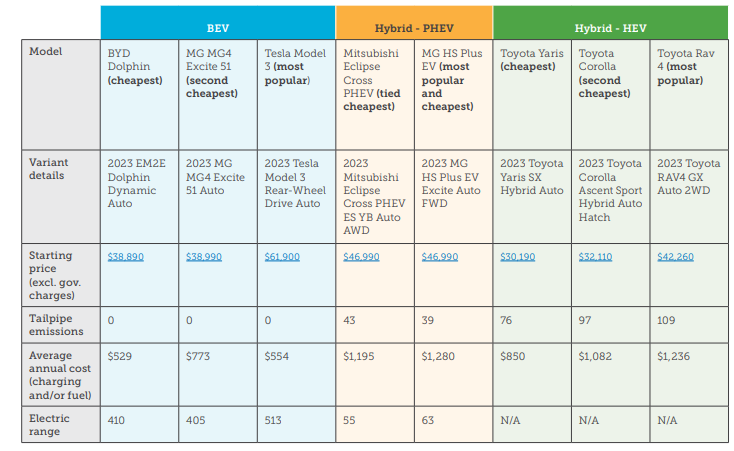
Finally, the following briefing paper prepared by the Climate Council gives some ideas of the potential costs of operating some of the more popular BEVs, PHEVs and HEVs currently available in Western Australia. Readers should bear in mind that this information is based on 2023 vehicle models and does not factor in essentials such as insurance, servicing, registration etc. This comparison is summarised in the table below.
Cost of insurance EVs VS ICE vehicles
On Average EVs are more expensive to insure in Western Australia and this is due to several factors…
- In general, EVs tend to be more expensive than ICE equivalents. However, as the market continues to expand more and more EVs are becoming available. Therefore, the gap between ICE vehicles and affordable EVs is narrowing.
- The technology in EVs is newer, making it more expensive to produce, repair or replace.
- The EV parts supply chain in Australia is still in its infancy. In addition, most of the manufacturing still takes place overseas which increase transportation costs.
- There are fewer service centres within the state that can service EVs compared to ICE vehicles and less qualified mechanics.
- Damaged EV batteries take time and specialised equipment to dispose of properly.
- Currently there is no parity between the supply and demand of various types of EV vehicles, which helps to drive up insurance premiums. This should ease in the long run, starting with HEVs as these are currently the most popular type of EV available in Western Australia.
- The greater complexity involved with extinguishing EV fires compared to ICE vehicle fires (see section on safety concerns relating to EV battery fires for more information).
Details on factors that are considered in calculating an insurance premium for an EV are provided in a May 2024 report published by the Insurance Council of Australia. A September 2024 article published by CarExpert, gives some insight into the current median price of insurance premiums between BEVs, ICE vehicles and HEVs purchased between 2002-2024. This is based on a market analysis by insurance provider Youi and shows that the cost of insuring BEVs generally increases with the purchase price of the vehicle. Other factors such as the complexity of repairs and the availability of trained technicians also plays a part in driving up premiums. Interestingly the article shows that HEVs are the clear winner when it comes to median insurance prices. However, this is with the understanding that there are other factors involved such as driver age, with most drivers under 25 operating an ICE vehicle.
Cost of registering an EV with the Department of Transport (DoT) VS an ICE vehicle
In Western Australia there is currently no difference in the methodology utilised for calculating vehicle registration fees between EVs and ICE alternatives. As explained on the DoT website the primary factor determining the cost of registration is the vehicles unladen weight rounded up to the nearest 100Kg. Therefore, the registration cost will be more expensive the heavier the vehicle. The table below approximates the 2024 registration costs of a base model Hyundai Kona, which comes as either an ICE or HEV, compared to a base model Hyundai Kona Electric, which is the BEV model of the vehicle with the lightest battery.
Base Model Kona (ICE & HEV) | Base Model Electric Kona (ZEV) | ||
Unladen Vehicle Weight (UVW) | 1335kg | Unladen Vehicle Weight (UVW) | 1,615kg |
UVW rounded to nearest 100kg | 1300kg | UVW rounded to nearest 100kg | 1,600kg |
2024 vehicle fee per 100KG | $27.56 | 2024 vehicle fee per 100KG | $27.56 |
Total Vehicle Weight Fee Calculation | Total Vehicle Weight Fee Calculation | ||
= 2024 vehicle fee per 100kg X UVW rounded to nearest 100kg/100 | = 2024 vehicle fee per 100kg X UVW rounded to nearest 100kg/100 | ||
= 27.56 X 1300 /100 | = 27.56 X 1600 /100 | ||
Total Vehicle Weight Fee | $358.28 | Total Vehicle Weight Fee | $440.96 |
Note: The example above is an estimate only and does not factor in admin fees or the addition of compulsory third-party insurance, the cost of which may vary between ICE, HEV and BEV vehicles (see section on cost of insurance EV vs ICE vehicles). Currently DoT does not distinguish between the cost of inspecting unregistered EVs or ICE vehicles.
Cost of roadside assistance EVs VS ICE vehicles
Roadside assistance for an EV is generally no more expensive than a regular ICE vehicle. Several manufacturers including Tesla, MG and Polestar offer free roadside assistance for the length of the vehicle (but not the battery) warranty period. Others such as BYD offer an initial 12 months with the option to add more onto the final purchase price of the vehicle. However, it is extremely important to read through the terms and conditions, since many manufacturers roadside assistance policies have limited coverage extending out from the nearest service centre.
In addition, most if not all BEVs are equipped with a tyre puncture repair kit, rather than a full size or space saver spare tyre. Due to the space/weight taken by the battery there is simply no room to accommodate a spare. Drivers should also be aware that most BEV breakdowns are attended to by a tow truck. It is generally more difficult to diagnose an BEV fault on the side of the road then it is with an ICE vehicle. Part of the reason for this is that there are far more complex electronics in an BEV as compared to an ICE vehicle. Drivers need to be aware of, which tow companies work with their chosen insurance provider to avoid unnecessary delays getting the vehicle returned to them. The disadvantage of BEV roadside assistance compared to ICE vehicles is therefore more a question of inconvenience rather than cost. Roadside assistance companies are looking into ways they can improve this such as providing the facilities for trickle charging to get an BEV with a depleted charge to the nearest charging station.
Current resale value in Western Australia EV vs ICE Vehicle
In the present market, BEVs and to a lesser extend PHEVs tend to have a relatively stable resale value for the first two years (average 82.8%), before this starts to depreciate significantly faster than ICE alternatives. The average days to sell an BEV vehicle is also higher than ICE equivalents. This is based on December 2023 data supplied by the Australian Automotive Dealers Association (AADA) in an article published in January 2024. There are several factors that influence this…
- The EV market is still relatively new in Western Australia and represents less than 2% of total annual vehicle sales as of June 2024
- EVs are generally far more expensive than ICE or HEV alternatives, however the gap is starting to narrow considerably and brand new EVs are becoming much more competitive. This has a negative impact on used EV prices.
- EV technology has improved significantly in short period of time, which impacts the value of older EVs over two years old.
- The degradation of the battery along with general wear and tear also has an impact on the vehicle’s resale value. If considering purchasing an EV second hand it is worth having the battery tested professionally.
- More EV manufacturers are attempting to enter the Western Australian Market, which is already quite small. These forces established brands to reduce prices to remain competitive and drives down prices on second hand EVs.
Average charge times for EVs
The Average charging time for EVs is dependent on several factors such as…
The capacity of the battery pack: This is typically measured in kilowatt hours (kWh) and varies by vehicle type. HEVs have the smallest battery pack (0.5 -2 kWh on average), which is recharged through a combination of regenerative breaking and the vehicles internal combustion engine. Due to the small size of the battery, HEVs are not meant to be driven on the battery alone. The primary benefit of driving a HEV over a regular ICE vehicle is the greater fuel efficiency. Following on from a HEV the PHEV has the next largest battery capacity (7-20kWh). While this can produce a range of between 60-100km on battery power alone, like the HEV the greatest advantage of a PHEV is its much greater fuel efficiency compared to a standard ICE equivalent. Finally, the BEV has the largest battery capacity (16-100kWh) as it relies solely on its battery for power.
The type of battery used in the vehicle: Battery technology has come a long way in the last 10 years. Currently there are three main types of EV battery in Western Australia, the pros and cons of each are summarised in the table below sourced from the CSIRO.
Chemistry | Common Applications | Pros | Cons | Example of EVs Using this Battery Type |
Lithium Iron Phosphate (LFP) | Stationary energy storage systems, EVs | Safe, long life, affordable | Lower energy density compared to NMC and NCA, also tend to be heavier. | MG, BYD, Tesla Model 3 |
Nickel Manganese Cobalt (NMC) | E-bikes, medical devices, EVs | High capacity, high power | Higher cost, greater risk of thermal runaway, which can result in fires | Polestar 2, BMW iX3 |
Nickel Cobalt Aluminium (NCA) | High performance EVs, electric trains | Highest energy density, fast charging | Higher cost, shorter life | Tesla Model S |
The outside climate conditions: can have an impact on the battery recharge process, with anything below 15°C or above 35°C starting to impact efficiency and rate of charge.
Driving Habits: can impact the rate in which an EV battery is discharged with heavy driving including frequent breaking and sudden stops and starts, having a negative impact on the rate of battery depletion. Almost all modern HEVs, PHEVs and BEVs are fitted with some form of regenerative breaking and the level in which the driver engages with such a system to help facilitate in transit battery recharge can greatly improve the overall duration.
The type of Charger used: to recharge the vehicle also has an impact upon the overall charging time. This only applies to PHEVs and BEVs as HEVs rely on internal charging through the regenerative breaking supplemented by the combustion engine. For PHEVs and BEVs there are essentially 3 options…
- 1.4 – 2.4 kW Level 1 EV Charger: utilises alternate current (AC) taken straight from a standard 240 volt household wall socket. On average this adds around 15km per hour and takes anywhere from 25-45hrs to charge the battery from 0% to 100%.
- 7, 11 or 22 kW Level 2 EV Charger: Also runs on (AC) current. The charger can safety draw more power than a standard wall socket and deliver it to a vehicle. On average this adds approximately 40km per hour. Charge time is approximately 9-12 hours from 20% – 80%.
- 50kW+ Level 3 EV Charger: This is a commercial grade charger and runs off direct current (DC). Due to expense of installation, as well as the power requirements they are generally restricted to commercial premises, LGAs and public carparks. A DC charger on average adds between 60km – 70km every 10 minutes
CAUTION: There are several factors to be aware of when deciding on upon the type of EV charging you will utilise…
- Most obvious is the distance you drive in a day or a week, depending on how often you are planning on recharging the vehicle.
- You should also never allow the battery to get under 20% capacity.
- If you daily commute is more significant you might start to look at investing in a Level 2 EV Charger to be installed at your home.
- The upfront expense of installing a household EV charger can be offset by applying for a green loan.
- The next thing you need to be clear on is whether or not your home runs off single – phase or three-phase power.
- Three-phase power allows you to charge the vehicle more quickly, since single-phase homes are restricted to 7kW Level 2 charges.
- A qualified electrician can be engaged to assess whether or not a single-phase home can be upgraded to three-phase.
- You need to be clear on whether the chosen vehicle is rated to accept a greater rate of power transfer over 7kW.
- If the answer is no, then upgrading your home for this sole purpose will not produce any benefit.
- To avoid damaging the battery, be clear on the maximum rate of DC current your EV can accept.
- Due to their smaller battery size many PHEVs, especially older models are not rated for DC charging.
- Relying on DC fast charging is not recommended as this can reduce battery lifespan.
Safety concerns relating to EV battery fires
In their May 2024 report the Insurance Council of Australia (ICA) has concluded that…
registered EVs do not present a greater risk of fire occurrence than ICE vehicles (pg 8).”
This is also supported by research undertaken by IDTechEX, a Cambridge based independent research institute, which found that…
current global data suggests that fires in EVs are much less common than ICE vehicles (pg 8).”
Therefore, the challenge with EV vehicle fires isn’t associated with a higher risk that they will occur, rather a question of how they are managed. Lithium batteries are essentially a fuel source and can burn for hours since, they are often very difficult to extinguish. Therefore, the risk to infrastructure is much greater. Property damage in the case of EV vehicle fires in enclosed spaces such as garages for example can be significant. To mitigate the risk EVs as well as, residential and commercial charging infrastructure are subject to rigorous manufacturing standards, Australian Standards and Australian Design Rules. The ICA report provides details on these and how they apply to EVs and EV chargers. New EVs and EV chargers emerging into the market also have built in safety features to monitor and regulate the temperature of the battery. In addition, many public chargers can monitor their own temperature and can shut down once the outside temperature has gone above the manufactures specified range, further enhancing safety.