

Examples of different types of rainwater tanks available ranging from
space saver (left), underground (middle) and cylindrical (right)
Background
This past summer has seen an unprecedented 9 days in the Perth metropolitan area where the maximum temperature has risen over 40°C. The truth is that this hot weather is likely to continue with some experts predicting that the Western Australian Climate will be 15% drier by 2030. This is going to have a cascading effect on the streamflow into Perth dams, which is already down 80% from 1970 levels as well as, the recharge of our groundwater aquifers, which are approximately 1,000 GL down from 1980 levels.
We can save an estimated 30GL from the restrictions the Water Corporation has brought into effect on the 180,000 Perth households with garden bores, which limits them to two days of watering in line with scheme water users. However, given the supply deficit, Perth is going to have to look to other sources of water to meet the supply shortfall. Given our proximity to the ocean the most readily available source is through the desalination of sea water. Unfortunately, this is an expensive and energy intensive process. As Perth becomes more reliant on desalination (65% by 2035) it is highly likely that the increased cost of production will be passed onto the consumer.
It is becoming clear that Western Australians need to become much more conscious of how they use water in the home as well as how they might go about capturing rainwater or recycling scheme water. Rainwater tanks and greywater diversion devices are two options households might want to consider looking into.
Rainwater Tanks
There are a large variety of different rainwater tanks available on the market to suit a variety of different needs and available space within the home and business. However, essentially each system has the following common parts:
- Roof space and gutters to collect rainwater run-off.
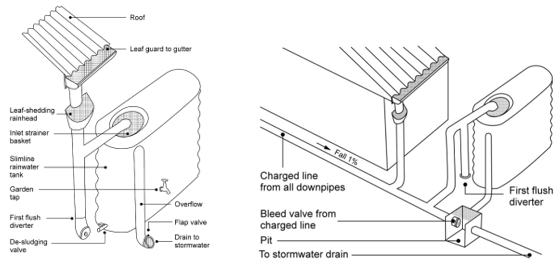
- A collection system to transport rainwater from the roof to the tank. This needs to include downpipes, leaf-shedding rain-heads, and first flush diverters to prevent water contamination.
- The rainwater collection tank itself, and
- A water supply system, possibly including pump and filters. Pumps tend to be required if the water supplied from the tank cannot reach where it is needed through gravity alone.
The basic set up of such a system is demonstrated in the two diagrams below. The system on the right is referred to as a charged line system. Such a system relies upon water pressure in the pipes, with the possible assistance of a pump to push water to where it is needed. This is necessary in cases where the slope of the ground is insufficient to move the water via gravity alone.
Sizing Your Tank
Typically, the size of the tank is dependent on what the rainwater will be used for. The following table provides a rough guideline for a family of four.
| Use | Target Volume (Litres) |
| Toilet Flushing and use on a small garden | 2,000 – 3,000 |
| Toilet flushing, clothes washing and small garden | 3,000 – 5,000 |
| Whole of house water supply (incl drinking water) | 5,000 – 20,000 |
The above table is only a rough guideline. The tankulator app, developed by renew1 with the assistance of the Victorian Government and product experts allows residents and businesses to get a much clearer idea of ideal tank size based on factors such as available roof space, no. of building occupants, estimated daily water use patterns etc.
It is also important to get a sense of the available rainfall you can expect to fill your tank. This can be obtained from the Bureau of Meteorology. You can then utilise the following calculation.
average annual rainfall (millimetres, mm) x 0.8 x roof area (square metres, m2) / 1000 = X (kilolitres [1000 litres] per year, kL/y) = Estimated rainfall available to fill tank.
Health Impacts & Regulatory Requirements
Given that it is possible to utilise rainwater for more than the garden (including as drinking water) it is important that perspective buyers have a clear understanding of the potential health impacts and strict construction and regulatory requirements governing the installation, use and maintenance of rainwater tanks. This includes a number of Australian standards, advice on how to prevent contamination (insects, faeces etc.) as well as recommended maintenance practices. The WA Health Website has a wide range of information on these requirements. It is also strongly recommended that residents and businesses that are considering installing rainwater tanks on their properties seek out the advice and recommendations of the Environmental Health Team working within the local government authority (LGA) that the property is situated in.
Planning Approval and Building Permits
Most LGAs will require either a building permit and/or planning approval, which will incur some financial cost to obtain, prior to an approval being granted for the installation of the rainwater tank as well as, any associated plumbing, pumps and fixtures required to secure it in place. Each LGA has different rules on what is required and under what circumstances. Therefore, it is Critical that enquires are made with the planning, building and environmental health teams of the LGA in question before the tank is purchased and scheduled for installation. The following examples highlight some of the potential influencing factors, which will again depend on the LGA in question.
-
- The size, volume (capacity) and height of the tank.
- Whether or not the tank or fixtures to secure it in place exceed the height of the overhanging roof space or a boundary fence.
- The stability of the ground the tank is to be placed upon (i.e. some form of pad might be required).
- The proposed uses for the water within tank, which will impact the type of filtration required as well as, safety mechanisms required to prevent backflow and other contaminants entering the tank.
- The connections utilised to connect the overflow to nearest storm water drain.
- The materials proposed for the construction.
When it comes time for installation it is strongly recommended that a licenced plumber that has obtained the Water Corporations Waterwise certification is engaged to ensure that the installation of the tank and associated plumbing is fully compliant with all state and LGA requirements.
Footnotes
- renew is a national not-for-profit sustainable initiative that advocates for the ability for people to live sustainably in both their homes and wider community.