
Understanding where Greywater comes from
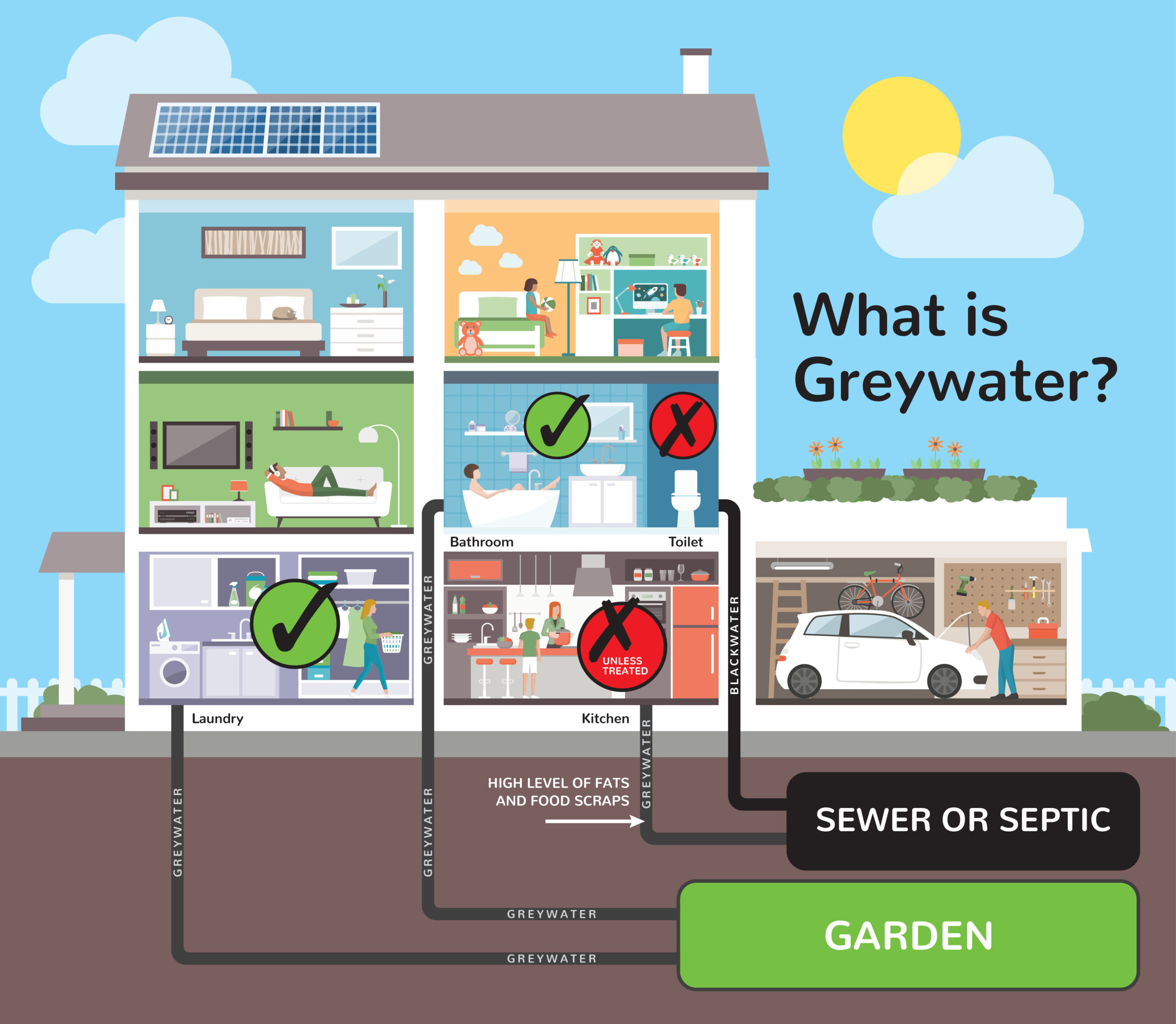
The water from your washing machine, laundry basin, shower, bath and bathroom basins are another matter. With some exceptions (e.g. washing soiled clothes, during prolonged periods of household illness) these sources of wastewater are generally considered to contain negligible levels of biological and chemical contaminants and therefore do not pose as high a risk to human health. It is this Greywater that can be diverted to irrigate your garden via a certified Greywater Diversion Device (GDD) and irrigation system (purple piping) so long as strict conditions are met.
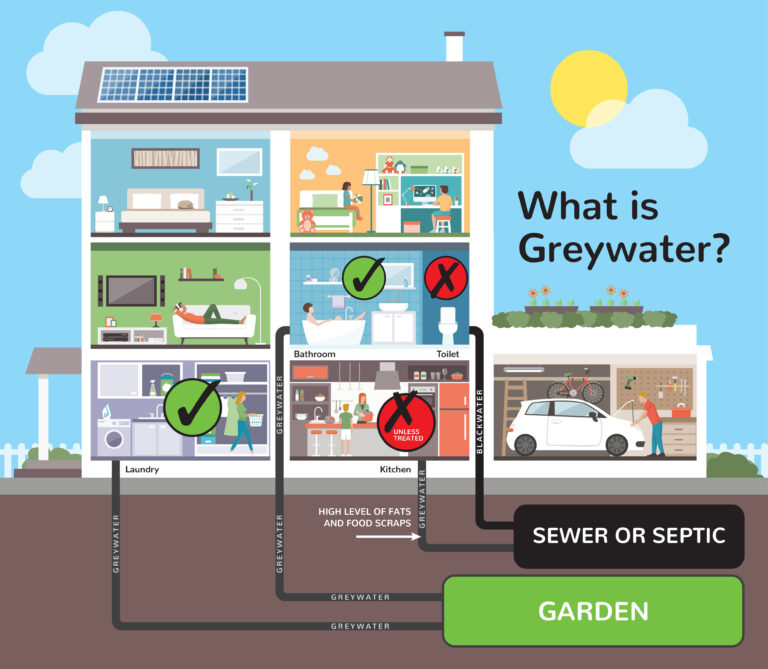
Concept Graphic: What is Greywater? (Source Washwise)
Greywater Diversion Devices
According to the Water Corporation the average Perth Household without a garden bore utilises around 277,000 litres of scheme water per year. Out of this around 40% is used on household gardens, which equates to around 110,800 litres per year. According to one 2020 study a properly installed greywater diversion device (GDD), set up with properly certified greywater drip irrigation system (purple piping) can save between 39% (43,212 litres) and 59% (65,372 litres) of this total amount of scheme water going onto the garden. The total amount saved is dependent on a number of factors including:
- The number of occupants in the home.
- The waterwise behaviours of said occupants.
- The number and type of water efficient fixtures installed throughout the home.
- The watering requirements and relative size of the household garden.
- The type of soil in the garden.
There are essentially two types of greywater diversion devices available. The first incorporates a hand activated valve, switch or tap. It is fitted to the outlet of the waste pipe of the plumbing fixture, such as a laundry tub. Greywater is immediately diverted to a subsurface drip irrigation system in the garden. The system relies upon gravity alone to transfer the irrigation through the pipework, so it is more suitable for households with sloped gardens. The second type of system contains a pump and either a sub-surface or surface surge tank. Once the level of greywater reaches a certain level in the tank it triggers a valve which activates the pump, and this diverts the greywater directly to the sub surface irrigation system. Since greywater is not meant to be stored due to stagnation and the associated health risks, both types of systems must contain a manual valve that can divert the greywater directly to the sewer or onsite septic storage system.
Calculating the Minimum Garden Area Required
The Australian and New Zealand Standard On-site domestic wastewater management (AS/NZS 1547:2000) states that the amount of greywater generated per day per person is fixed at 60 litres/day/person in the bathroom and 40 litres/day/person in the laundry. Therefore, a family of 4 would generate approximately 400 litres of greywater per day.
Before considering anything, else residents need to determine whether or not they have sufficient garden area to make a Greywater Diversion Device Viable. The calculation used is based on three distinct factors:
- The number of bedrooms in the home as an indicator of the number of occupants i.e. bedroom 1 = 2 occupants every other bedroom = 1 occupant.
- A fixed rate of greywater production per occupant i.e. 100 Litres/day/person as set out in AS/NZS 1547:2000.
- The design irrigation rate (DIR) of the garden soil
- Sandy Soil – 10mm/day
- Loam (black) Soil – 5mm/day
- Clay Soil – 2mm/day
As an example, consider a 3 Bedroom 235m2 House on a 475m2 block on sandy soil.
- No. Occupants Bedroom 1 = 2 occupants, bedroom 2 & 3 = 1 occupant each = 4 Occupants in total
- Fixed daily greywater production = 60L/person/day (bathroom) + 40L/person/day (laundry) = 100 Litres/day/person x 4 Occupants = 400 litres/day total
- DIR of sandy soil = 10mm/day
- Garden Area required for Greywater Diversion Device to Operate Correctly = 400/10 = 40m2
Other Considerations
There are several additional factors that need to be taken into consideration when trying to determine whether or not your household is suitable for a greywater diversion device. These include but are not limited to:
- The depth of the soil: The WA Department of Health requires that all drip lines attached to a greywater diversion system are buried at least 10cm below the soil surface. However, if the soil layer is shallow before it hits the bedrock (<0.6 metres) it can prevent nutrient flow and result in greywater pooling back up to the surface and stagnating, which poses an unacceptable health risk.
- Slope: It is a requirement that any distributed greywater remains within the boundaries of the property where the greywater diversion device is situated with no less than a 0.3 metre gap between the point of irrigation and any neighbouring property. If the ground is sufficiently sloped it can risk greywater leaching and then pooling in neighbouring properties, which is again considered to be an unacceptable health risk.
- Proximity to drinking water: The Department of Water and Environmental Regulation (DWER) oversees 140 public drinking water sources in Western Australia. Properties located within 5km of one of these supply sources must obtain written permission from the department prior to installation of a greywater diversion device.
Further Research
It is strongly recommended that homeowners and businesses familiarise themselves with the following documentation prior to commencing the applications process.
- Western Australian Department of Health Code of Practice for the Reuse of Greywater in Western Australia 2010.
- Western Australian Department of Health Website, which contains instructions on how to apply for either a domestic or commercial greywater system.
- Western Australian Department of Health Health (Treatment of Sewage and Disposal of Effluent and Liquid Waste) Regulations 1974.
- Water Corporation The West Australian Greywater Guide 2019.
In addition, it is essential that homeowners and businesses considering installing a greywater diversion system reach out to the planning, building and environmental health teams of their Local Government Authority (LGA), so they are able to understand the unique requirements specific to their LGA.
4 Step Application Process
Note: The following assumes that an initial assessment of the suitability of the property for a greywater diversion device has already been performed and that a supplier has been contacted to provide initial plans for the system (refer to supporting documentation in step 2 below).
Step 1: Product Approval (Manufacturer): On its website the WA Department of Health states that all greywater diversion devices must be WaterMark certified to ensure they are fit for purpose and authorised for use in plumbing and drainage. They must also be authorised for use by the Chief Health Officer. As of time of publication the following Greywater Diversion Systems are approved for use in Western Australia.
|
Model ID |
Model Name |
Brand Name |
Description |
|
EZGREY |
EZGREY |
Greywater Diversion System for use with Multiple Sources Above Ground or Partly Buried Utilising a Submersible Pump |
|
|
Grey Flow PS |
GREY FLOW |
GREY FLOW |
Grey Water Diversion Device for use with Multiple Sources Below Ground and Utilising a Submersible Pump |
|
Grey Flow Pro Commercial |
GREY FLOW |
GREY FLOW |
Grey Water Diversion Device for use with Multiple Sources Below Ground with Disinfection and Utilising a Pump |
|
Grey Flo Pro Domestic |
GREY FLOW PRO Domestic |
GREY FLOW |
Grey Water Diversion Device for use with Multiple Sources Below Ground (Max Depth No Greater than 1.3m) and Utilising a Pump |
Note: This is also subject to approval by your LGA.
Step 2: Applicants will then need to submit an Application to Construct or Install an Apparatus for the Treatment of Sewage directly to the Environmental Health Team of their Local Government Authority (LGA):
- For systems handling less than 540L/day of wastewater OR the building to be serviced is a single dwelling the LGA will assess the application.
- If the wastewater volume generated is more than 540L/day AND the building being serviced is not a single dwelling the LGA will assesses your application, prepare a local government report and forward the application and their report to Department of Health (DOH), Environmental Health Directorate for approval. In this scenario it is recommended that applicants review the DOH Guidance on applying for approval of installation of a commercial onsite wastewater system to support their submission.
- Applicants must be prepared to provide supporting documentation with their application which may include:
- Greywater source(s) to be reused (eg laundry or bathroom etc).
- Number of bedrooms in the house.
- Brand name and details of the proposed system.
- A detailed site layout plan (in duplicate or triplicate as the case requires) drawn to a scale of 1 in 500 showing:
- Block dimensions;
- Natural ground contours, wells, bores, dams, watercourses and depth to groundwater;
- Existing and proposed buildings, other structures and paved areas;
- Details and location of any diversion trenches to collect surface or migrating subsurface water;
- Details and location of roof water disposal;
- Setback distances from boundaries, buildings, surface irrigation area and other structures and details of the sewer overflow pipework where this is intended.
- Details of the treatment and irrigation systems including:
- Proposed location of greywater system and reuse area including the position of irrigation lines/trenches;
- Method of construction of surface irrigation area bed, including the materials to be used; and
- Where a split irrigation system is used; details of mechanisms to ensure an even discharge to each area and to prevent overloading of individual areas.
- Further information on the potential variations to the application process are provided in Appendix 1 of the application form. Details on potential variations to pricing depending on the complexity of the application process are provided in Appendix 2 of the application form.
Step 3: It the property where the proposed greywater diversion system installation is proposed to take place is within 5km of one of the Department of Water and Environmental Regulation (DWER) 140 public drinking water sources, approval will need to be sought in writing from DWER and submitted to your LGA along with your application form. Applicants can determine whether or not their property is within a 5km radius of one if these drinking water sources by utilising the departments online mapping tool. If this proves to be the case further clarification and written permission can be sought by contacting the department directly at info@dwer.wa.gov.au.
Step 4: Before the system can be utilised it is essential that homeowners and businesses receive a Permit to Use from their Local Government Authority (LGA). The specific requirements are unique to each LGA and may require an onsite inspection (possibly subject to fees) by the environmental health team to ensure that the installation has been done correctly and that the system is compliant with all WA Health regulations and LGA local laws.
Important Note: The operation of a greywater system prior to obtaining a Permit to Use is subject to financial penalty and may possibly require the removal of the system. Residents and businesses should refer to their Local Government Authority (LGA) for more information.
A Summary of Some of the Do’s and Don’ts of Greywater
Do’s
- Wash your hands after touching grey water to remove any unwanted biological and chemical contaminants.
- Test the PH, sodium, nitrogen and phosphate levels of your garden soil.
- Use garden-friendly cleaning products that are biodegradable, and contain appropriate levels of nitrogen, sodium and phosphate to balance out natural soil contents with the application of natural fertilisers.
- Use greywater certified drip irrigation (purple piping) to water your garden preferably under mulch and within channels a minimum of 10cm under the soil.
- Perform system regular maintenance as per system specifications and guidelines
- You must divert grey water to the sewer during wet periods, while washing soiled clothes and during household illness.
- Ensure you are familiar with all WA Health regulations, guidelines and all relevant local laws and procedures.
- Use a licensed plumber to install your system and perform annual maintenance.
- Make sure you contain grey water within your property and that it is not allowed to pool or leach under any circumstances.
Dont’s
- Store untreated grey water for more than 24 hours (absolute maximum)
- Use grey water to water vegetables, fruit, and herbs that are eaten raw or partly cooked. Some fruit trees (apple and pear etc.) are suitable if direct to roots.
- Use grey water sourced from washing nappies or soiled clothes
- Use grey water that has antibacterials, disinfectants and bleaches in it
- Use grey water from kitchens, unless it has been treated (Currently no WA Health approved systems available)
- Use grey water that is still hot as it will kill beneficial organisms in the soil
- Spray or hose grey water, it should only be supplied by sub surface drip irrigation.
- Allow people or pets to drink grey water under any circumstances.
Additional Benefits of Utilising Greywater
Other than saving a substantial proportion of scheme water that would otherwise go on the garden, there are a number of additional benefits to utilising greywater in the garden through an approved Greywater Diversion Device. These include:
- Additional nutrients for plants (including phosphorous and nitrogen). This can be enhanced further by utilising products certified as being safe for greywater systems including natural cleaners and laundry liquids from brands such as Earth Choice (exc. dishwasher tablets), Organic Care and Natures Organics.
- Exemption of greywater from summer water restrictions, which is beneficial when struggling to keep gardens alive in extreme heat.
- Creating cooler and greener neighbourhoods by providing opportunities to effectively combat the negative impacts of the Urban Heat Island Effect on liveability and wellbeing.
- Contributing towards the State Governments target to increase wastewater recycling by 30% by 2030.
- Contributing to a reduction in the energy requirements and greenhouse emissions associated with the treatment of wastewater.